



 Everyday Floor Cleaning Starter Kit · $149.00
 Everyday Floor Cleaner Concentrate · $49.00
 Everyday Spray Mop · $94.00
 Replacement Mop Heads · $19.00

7 Reasons a Spray Mop with a Refillable Bottle Is the Last Mop You'll Ever Buy
Aug 17, 2026
Let's be honest. Mopping the floor is nobody's idea of a good time. Between lugging around a heavy bucket, wringing out a soaking wet mop head, and somehow ending up with floors that still look streaky, it's no wonder most people dread cleaning day.
But what if there was a smarter, simpler way to get the job done? That's exactly where a spray mop with refillable bottle comes in, and once you try one, you'll seriously wonder how you ever lived without it.
These clever cleaning tools have been quietly winning over homeowners everywhere, and for good reason. They're lightweight, easy to use, and surprisingly affordable over time. Whether you're setting up your first home or just tired of your old mop making a mess of things, this guide is for you.
In this post, we're breaking down seven solid reasons why a spray mop with a refillable bottle might just be the last mop you ever need to buy. Stick around, because number four alone might completely change the way you think about floor cleaning.
What Even Is a Spray Mop with a Refillable Bottle?
Think of it like this: instead of dragging out a bucket, filling it with water, dunking a mop, wringing it out (and getting your hands wet in the process), and sloshing around the floor, a spray mop keeps everything contained in one lightweight tool. There's a refillable bottle built right into the handle. You fill it with your cleaning solution, and when you're ready to mop, you press a trigger or button that sprays a fine mist directly onto the floor in front of you. The flat mop head glides through it and picks up the dirt. Done.
Compared to the old bucket-and-mop setup, it's night and day. Traditional mops tend to over-saturate floors, take ages to dry, and honestly, as research on spray mops vs traditional mops points out, they can harbour a surprising amount of bacteria in that soggy mop head. Single-use pad mops are a step up in convenience, but they lock you into buying proprietary replacement pads and pre-loaded cartridges forever. That gets expensive fast.
The refillable bottle is the part that actually changes everything. It gives you control over how much solution hits the floor, which means less over-wetting, faster drying, and a much lower risk of damaging your floors. It's not a gimmick; it's the whole system working as it should.
And here's the thing: what you put in that bottle matters just as much as the bottle itself. The right cleaning solution, especially a concentrated one designed for your floor type, can make a massive difference in results. More on that shortly.
Reason 1: It Actually Saves You Money Per Clean
Let's talk money, because this is where a spray mop with a refillable bottle really starts to make sense.
Here's something most people don't realise: when you buy a pre-mixed floor cleaner from the supermarket, you're mostly buying water. According to research on conventional cleaning products, water makes up 80 to 95% of most ready-to-use sprays. You're paying retail price, plus packaging costs, plus the shipping weight of that water, every single time you grab a new bottle. It adds up faster than you'd think.
Now flip the model. A concentrated cleaner works completely differently. You add a small amount of concentrate to your refillable mop bottle, top it up with tap water at home, and you're done. The water is essentially free. What you're actually paying for is the cleaning chemistry itself, not the filler.
Research from the San Francisco Department of the Environment found that ready-to-use products average 15 times more expensive per unit than equivalent concentrates. That's not a rounding error. That's a structural cost difference baked into how conventional cleaning products are designed and sold.
A practical example makes this click. Our NZ-made concentrated cleaner is designed to dilute into your spray mop's refillable bottle, stretching one small bottle of concentrate across a serious number of cleans. Compare that to buying a new pre-mixed bottle at the supermarket each time, and the savings become pretty obvious pretty quickly.
It turns out consumers globally are catching on. The spray mop market is growing at a rapid pace, with forecasts tracking a CAGR of 7 to 14% through 2033, partly because people are waking up to exactly this cost equation. Paying for water, packaged in single-use plastic, delivered to your door, just doesn't make sense anymore when the smarter alternative is sitting right there.
Reason 2: You Stop Throwing Away Plastic Every Few Weeks
Think about how many plastic bottles you've quietly tossed in the bin over the last year. Floor cleaner, multi-surface spray, bathroom cleaner. It adds up fast. For floor cleaning alone, the average household likely goes through somewhere between 12 and 24 pre-mixed bottles a year, depending on how often you clean and how big your place is. That's a rough estimate, but even at the low end, that's a small shopping bag full of plastic, just from mopping your floors.
And here's the uncomfortable part: most of those bottles don't actually get recycled. Cleaning product bottles often have residue left inside, which makes them harder to process through standard recycling programs. A lot of them just end up in landfill. When you zoom out, the scale of the single-use plastic problem is genuinely staggering, with 8.3 billion metric tons of plastic produced globally since the 1950s and single-use formats still driving a huge chunk of ongoing waste.
The good news is that this is exactly where refillable cleaning products make a real, visible difference. When your spray mop has a refillable bottle and you're topping it up with a concentrated cleaner, you're keeping the same bottle in rotation for months. You're not adding to that pile every few weeks.
It's also worth knowing this isn't a fringe idea anymore. Refillable formats are going mainstream across personal care, laundry, and household cleaning, and governments worldwide are tightening regulations around single-use plastics, which is pushing manufacturers in this direction whether they like it or not.
I'm not here to lecture anyone. I drive a petrol car and my kids use way too many zip-lock bags. But swapping to a refillable mop system is a genuinely easy change that costs you nothing extra and quietly cuts a meaningful amount of plastic out of your household waste. That feels like a pretty reasonable trade.
Reason 3: The Right Formula Is Safe for Every Hard Floor in Your Home
Not all floors are created equal, and honestly, neither are the cleaners sitting on supermarket shelves.
Here's the thing about hard flooring: wood is the most chemically sensitive surface in your home. Engineered timber, solid native timber, and laminate all have one big vulnerability in common. They don't like moisture sitting on them, and they really don't like harsh alkaline cleaners. Too much of either and you'll start to see warping, swelling, finish dulling, or that cloudy residue that never quite wipes off. Laminate is especially unforgiving because underneath that printed wear layer is a compressed fibre core that soaks up water like a sponge if you give it the chance.
Why pH Actually Matters (Without Getting Too Technical)
pH is just a way of measuring how acidic or alkaline something is, on a scale from 0 to 14. Seven is neutral, like water. Most floor finishes, whether polyurethane, aluminium oxide, or a factory-applied coating on vinyl plank, are designed to stay intact when cleaned with something close to neutral. Cleaners that sit too high on the alkaline end of that scale can slowly strip or cloud your floor's protective finish over time. You might not notice it after one clean, but after six months of regular mopping? You'll notice.
A pH-balanced formula protects that finish, clean after clean, for the long haul.
If It's Safe for Wood, It's Safe for Everything
Here's the logic that makes a wood-safe cleaner such a smart all-rounder: if a formula is gentle enough for the most sensitive hard floor in your home, it's going to be completely fine on everything else. Vinyl plank, tiles, sealed concrete; none of these are more delicate than timber. So you're not compromising, you're actually just using the safest option across the board.
That's exactly how our concentrated cleaner is formulated here in New Zealand. It covers:
Engineered timber
Solid native timber
Laminate
Vinyl plank
Sealed concrete
Tiles
And because the spray mop uses a refillable bottle, you're in control of what actually touches your floors. With pre-loaded or cartridge-based systems, you're stuck with whatever formula came in the box, with no way to swap it out for something gentler or more appropriate for your specific floor type. That's a real problem if you've got a mix of surfaces throughout your home, which most New Zealand households do.
Reason 4: It's Genuinely Easy to Use (Here's Exactly How)
Let's be honest, the biggest reason most people don't mop regularly is because it feels like a whole production. Dragging out the bucket, waiting for it to fill, winging the dilution ratio, and somehow ending up with soaking wet floors that take forever to dry. With a spray mop, the whole process genuinely simplifies down to a few easy steps.
Here's how it works in practice:
Start by removing the refillable bottle from the mop. Add your concentrated cleaner first, then fill the rest with water. For a concentrated formula like ours, you're typically looking at a small amount of cleaner, think a capful or two, topped up with water to fill the bottle. That's it. No guessing, no overpouring. Screw the lid back on, click the bottle back into its seat on the mop, give the trigger a couple of priming pulls, and you're ready to go.
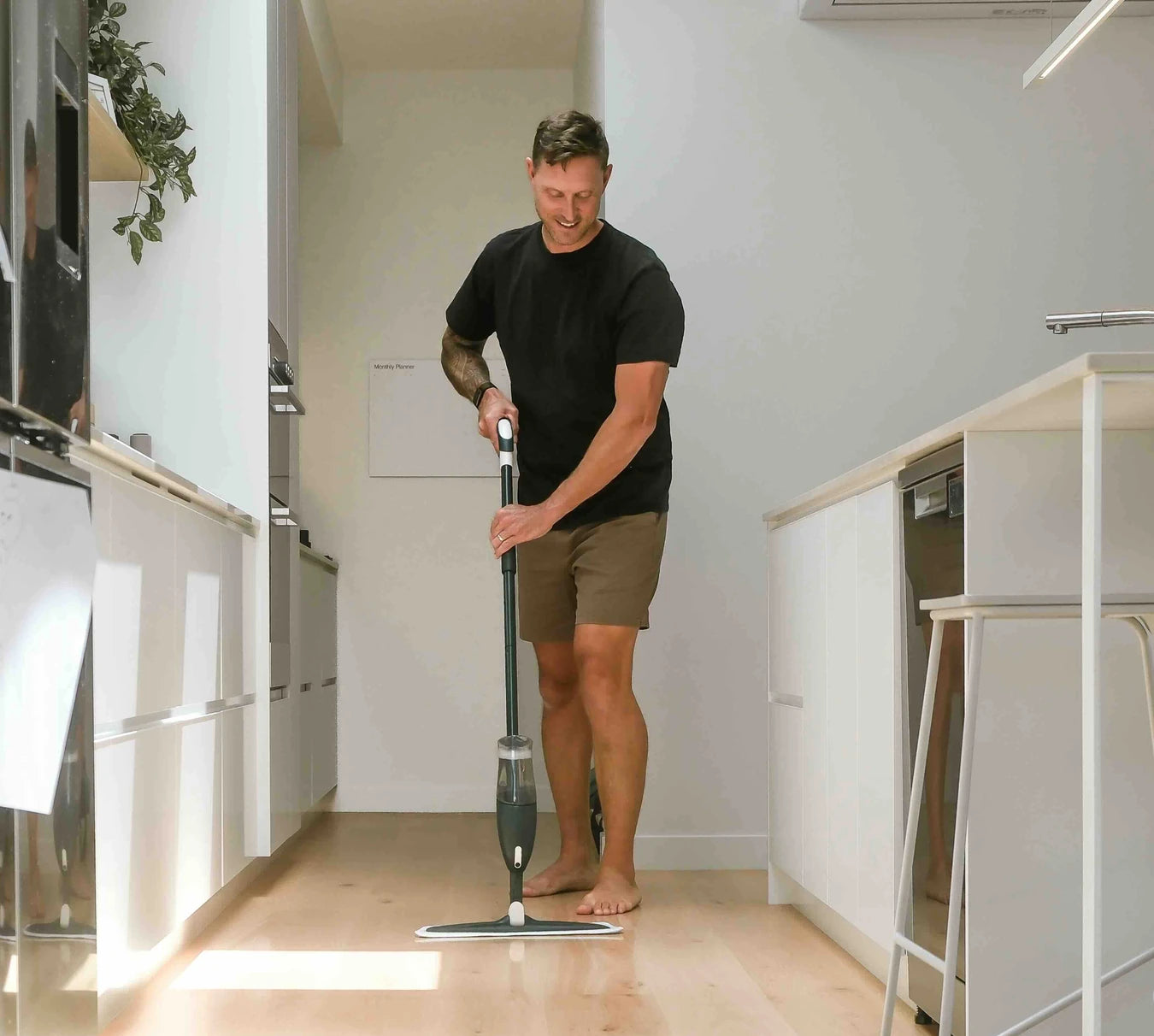
One of the most common worries people have is over-wetting their floors, especially if they've got timber or laminate. This is where a spray mop is genuinely different. Instead of flooding the floor like a traditional bucket-and-mop, the trigger delivers a fine, controlled mist directly in front of the mop head. The floor gets just enough moisture to lift dirt without soaking through to the subfloor. By the time you move to the next section, the area behind you is already dry.
The best technique is simpler than you think: work in manageable sections rather than spraying a large area all at once. Let the mop head do the actual cleaning work, using light, overlapping passes. You're not scrubbing; you're guiding.
For everyday maintenance cleans, most open-plan living areas take under 10 minutes. Spray, mop, move on. The near-instant dry time means no waiting around either.
If you can squeeze a trigger and push a mop forward, you've already mastered this. There is no learning curve. Seriously.
Reason 5: When It Wears Out, You Replace the Head — Not the Whole Thing
Here's something that bugs me about a lot of cleaning products: they're basically designed to be thrown away. The pad wears out, or the spray trigger breaks after six months, and suddenly the whole thing goes in the bin. Handle, reservoir, mechanism and all. That's a lot of plastic heading to landfill for what was essentially a worn-out sponge pad.
Disposable mop systems are a perfect example of waste built into the design. When the refill pads run out or the plastic trigger stops working, there's no logical fix. You just buy another one. And then another. It's a cycle that costs you money and adds to the growing pile of plastic waste that our recycling systems genuinely can't keep up with.
A quality spray mop with refillable bottle works completely differently. The frame, handle, and bottle are built to last for years. When the mop head eventually wears out from regular use, you simply swap it for a replacement head and keep going. Same mop, fresh clean surface, no unnecessary waste. One frame doing years of work instead of a new unit every few months.
The cost and sustainability arguments here are basically the same argument. Fewer replacement purchases means less money spent and less plastic manufactured in the first place. The environmental impact of reusable mop systems versus disposable alternatives is significant when you zoom out over a few years of regular cleaning.
We also sell felt pads as part of our accessories range, and honestly they're one of those small details that make a real difference, especially on timber and vinyl plank floors. They sit under furniture legs and protect your flooring from scratches during cleaning and everyday movement. Easy to overlook, but genuinely useful.
That's the bigger picture here. When you buy a spray mop from us, you're buying into a complete floor care system: the mop, our New Zealand-made concentrated cleaner, replacement heads, and accessories like felt pads. Everything works together, and everything is replaceable. That's what makes it a long-term solution rather than just another product you'll be replacing in six months.
Reason 6: It Was Built for People Who Actually Have Lives
Let's be real for a second. If you've got kids, a pet, or just a house where people actually live in it, your floors get wrecked on a daily basis. Muddy shoes, food spills, crumbs that somehow travel three rooms from the kitchen. You know the drill. The problem isn't that people don't want clean floors. It's that the traditional way of cleaning them asks too much of people who are already stretched thin.
Nobody in a busy household has 45 minutes to dedicate to mopping twice a week. And when the alternative is dragging out a bucket, filling it, mixing in cleaner, lugging it across the house, wringing out a heavy mop head repeatedly, and then waiting what feels like forever for the floors to dry... most people just don't. They put it off. And off. And then off again.
The spray mop removes almost all of that friction. You grab it, you press the trigger, you mop, you're done. No bucket to fill or empty. No wringing. No soaking wet floors that the dog immediately walks across. The floors dry quickly because you're applying a fine, controlled mist rather than dumping water on them. That's not just more convenient; it's actually better for your floors, especially if you've got timber, laminate, or vinyl plank.
There's also something worth mentioning that gets overlooked: anyone in the house can use it. It's lightweight and straightforward enough that it doesn't require the one person who knows the "system" to be home. Partners, older kids, whoever is around can pick it up and get the job done without a tutorial.
Professional cleaners in the UK who mop floors for a living overwhelmingly prefer spray mops over bucket-and-mop setups for exactly this reason: ease of use wins. And that consensus reflects something important. You're far more likely to mop regularly if it doesn't feel like a production. Regular, lighter cleans are genuinely better for your floors long-term than occasional deep mops that over-wet the surface. Less friction means more frequent cleaning, and more frequent cleaning means your floors stay in better shape for longer.
Reason 7: Where Your Cleaner Comes From Actually Matters
Most people grab whatever floor cleaner is on special at the supermarket and call it a day. I get it, I've done it too. But when you're using a spray mop with a refillable bottle, you actually have a choice about what goes inside it. And that choice matters more than you'd think.
Here's why: a generic imported pre-mixed cleaner is formulated somewhere overseas, for some average floor type, with no particular consideration for your home. You don't know the pH, you don't know how it'll interact with the finish on your engineered timber or vinyl plank, and you have no idea how long it's been sitting in a warehouse before it hit the shelf. A locally made concentrate, on the other hand, is formulated and tested here. You know what's in it, you know where it came from, and there's no mystery supply chain between the manufacturer and your floor.
This is especially relevant right now because NZ new builds have shifted heavily toward engineered timber and luxury vinyl plank. These floors look incredible, but they're more sensitive to the wrong cleaner than people realise. The wrong pH or surfactant blend can dull the wear layer over time, leave a residue, or cause streaking. A cleaner that's specifically wood-safe, and formulated with these surfaces in mind, is a genuinely better fit for the floors most Kiwis are actually living on.
There's also something to be said for supporting local. Not in a lecturing way, just practically speaking: shorter supply chain means less packaging, less transport, and a smaller footprint overall. That aligns with the whole point of a refillable system.
That's what makes a complete system so much more considered than a cheap mop paired with whatever bottle happens to be on promotion. When you've got the mop, the NZ-made concentrate, the replacement heads, and the felt floor protection pads all working together, every part of it has a purpose. It's not an afterthought, it's a proper setup built around protecting your floors for the long run.
What to Actually Look for When Buying a Spray Mop with a Refillable Bottle
Not all spray mops are created equal, and a bit of due diligence before you buy will save you a lot of frustration down the track. Here are the five things worth checking before you commit.
Bottle capacity and how easy it is to refill. Most bottles on the market sit somewhere between 400 ml and 800 ml. For a small apartment, either end of that range works fine. For a larger home, a bigger bottle means fewer trips to the sink mid-clean. But capacity is only half the story. How the bottle actually comes off, fills, and reseats matters just as much. Look for a mechanism that's genuinely one-handed and doesn't drip when you reattach it.
Mop head material and washability. Microfibre is the standard for good reason. It picks up more, it's gentle on floors, and you can throw it in the washing machine when it's done. Avoid systems that lock you into disposable pads. The cost adds up fast, and the waste is unnecessary.
Compatibility with concentrated cleaners. Some mop systems are designed to work only with water or proprietary refill cartridges. That limits your options and usually costs more over time. A good spray mop with a refillable bottle should work with any quality concentrated cleaner, giving you full control over what goes on your floors.
Replacement heads and accessories. A mop is only a long-term investment if you can actually get parts for it. Before buying, check that replacement heads are sold separately and are easy to source. Our replacement microfibre heads and felt floor protection pads are always available, because a complete floor care system shouldn't become landfill the moment one part wears out.
Floor-type suitability. This one matters more than people realise. If you have timber, engineered wood, or laminate, you need a mop and cleaner that are explicitly safe for those surfaces. Too much moisture or the wrong formula can cause swelling, warping, or dull the finish over time. Our system was built with wood floors in mind first, which means it's safe across all hard flooring without any guesswork.
The Bottom Line
If you've made it this far, the argument kind of makes itself. A spray mop with a refillable bottle beats a bucket mop for hygiene and convenience, and it beats a disposable pad system on cost and waste. Those three practical wins, spending less per clean, sending less plastic to landfill, and actually finishing the job in under ten minutes, aren't small things when you're juggling work, kids, and everything else that fills up a week.
But the mop is only part of the equation. What you put in the bottle matters just as much. A wood-safe, concentrated formula stretches further than any pre-mixed bottle from the supermarket, and because wood is the most chemically sensitive floor type around, something safe for timber is safe for every other hard floor in your home too, tiles, vinyl plank, laminate, sealed concrete, all of it.
Think of it as a complete floor care system rather than a single purchase. The mop, the cleaner, the replacement heads, the felt pads for furniture protection. When those pieces work together, you get consistent results without the guesswork.
If that sounds like what you're after, it's worth taking a look at the Abstract Floor Care spray mop system. It's designed and made here in New Zealand, with local floors and local conditions in mind. A practical, locally considered option for busy households that just want clean floors without the fuss.
Conclusion
Cleaner floors really do not have to mean more effort, more expense, or more frustration. A spray mop with a refillable bottle checks every box: it saves you money over time, cuts down on waste, and makes the whole mopping experience faster and more enjoyable. It is lightweight, simple to use, and built to last well beyond the lifespan of a traditional mop setup.
If you are tired of dreading cleaning day, this is the upgrade your home routine has been waiting for. Pick a model that fits your floor type, fill it with your favorite cleaning solution, and experience the difference for yourself.
The best cleaning tool is one you will actually want to use. Make the switch today, and say goodbye to the bucket, the wringer, and the streaky results for good.