



 Everyday Floor Cleaning Starter Kit · $149.00
 Everyday Floor Cleaner Concentrate · $49.00
 Everyday Spray Mop · $94.00
 Replacement Mop Heads · $19.00

Why a Spray Mop with Microfiber Pads Beats a Bucket Every Time
Aug 17, 2026
Let's be honest: lugging around a heavy bucket of sloshing water while trying to mop your floors is nobody's idea of a good time. You end up with soaking wet floors, a sore back, and somehow the mess looks even worse than when you started. Sound familiar?
Here's the good news. There's a much easier way to keep your floors sparkling clean, and once you try it, you'll never go back to the old bucket method. A spray mop with microfiber pads is changing the way people clean their homes, and for very good reasons.
Whether you're a first-time homeowner or just someone who wants to make cleaning day a little less painful, this list is for you. We're breaking down all the ways a spray mop with microfiber pads leaves the traditional bucket and mop method in the dust. From saving time to getting a deeper clean with less effort, you're about to discover why so many people are making the switch. Let's dive in!
What 'Microfiber Pads' Actually Means (and Why It Matters)
Not all microfiber pads are created equal, and the difference matters more than most people realise when you're trying to actually clean your floors rather than just push wet dirt around.
GSM is the number that actually counts. GSM stands for grams per square metre, and it measures how densely the fibres are packed into the pad. A higher GSM means more fibre, more surface contact, and more absorption per swipe. Low-GSM pads might technically be labelled "microfiber," but they behave more like a thin damp cloth, smearing fine particles and moisture across your floor rather than lifting them. When you're mopping hardwood or timber floors, that difference is the gap between a clean finish and a streaky mess.
The split-fibre structure is where the real magic happens. Quality microfiber isn't just thin synthetic fabric. Each strand is split into up to 16 individual fibres during manufacturing, creating a cross-section shaped roughly like an asterisk. That structure dramatically increases surface area and, importantly, creates a positive static charge that physically attracts and traps particles rather than pushing them around. A cotton string mop or low-grade flat pad can't do this because the fibres are simply too coarse to enter the tiny grooves in your floor surface. Dirt gets relocated, not removed.
Reusable pads win on cost, every time. A quality microfiber pad rated for 200-plus home machine washes, used twice a week, covers roughly two years of regular mopping. Compare that to single-use disposable pads or proprietary refill systems where you're buying consumables every few weeks. Over a full year, the cost difference adds up fast, and reusable pads produce significantly less waste.
When buying replacement pads, three things matter most: size compatibility with your specific mop frame (a pad even slightly too wide can cause cleaning coverage gaps or snag on the mop mechanism), a clear machine-washability rating, and the attachment system. Velcro tabs wear out over time, so check the fastener quality before assuming any pad will fit your system long-term.
When we spec'd the microfiber pad for the Abstract Floor Care system, the priorities were split-blended fibre construction, sufficient GSM density to absorb the spray solution without over-saturating delicate timber, and dimensional precision matched exactly to the mop frame. Floors dry quickly, no streaks, and the pads are fully machine washable. That's the standard we held ourselves to.
Why Spray Mops and Timber Floors Are a Natural Fit
Let's talk about the thing that keeps timber floor owners up at night: water.
Not a little water. The kind that pools under a sopping wet mop head, seeps into the gaps between boards, and slowly does damage you won't even notice until your floor starts cupping, swelling, or the finish begins to lift. This is exactly what traditional bucket mopping does on a regular basis, and if you've got timber floors, every time you mop the old-school way you're rolling the dice a little.
The good news is that a spray mop is genuinely designed around this problem, not just marketed around it.
Controlled Moisture Changes Everything
When you pull the trigger on a spray mop, you're releasing a fine, even mist directly in front of the mop head. That's it. No dripping, no wringing, no guessing how wet is too wet. The microfiber pad picks up that small amount of moisture along with the dirt, and the floor dries in seconds rather than minutes.
This matters everywhere, but it matters most on timber. Engineered timber, which makes up a huge proportion of flooring in NZ new builds, is built for dimensional stability, but even certified moisture-resistant boards should never have standing water sitting on them. And older NZ homes with solid native timbers like rimu, matai, or kauri? Those floors are often irreplaceable, and they're far less forgiving. A spray mop gives you just enough to clean, and not a drop more.
One System, Every Floor in the House
Here's something worth knowing if you're upgrading from a bucket mop: you do not need a different mop for every floor type. This is one of the most common (and costly) misconceptions I hear from homeowners. If a cleaning method is safe and gentle enough for sensitive solid timber, it is absolutely fine on laminate, vinyl plank, sealed concrete, and tiles. These floors are actually less moisture-sensitive than timber, so the logic writes itself.
The same spray mop, the same microfiber pad, the same concentrated cleaner works across every hard floor in your home. NZ homes often have a mix of flooring types across different rooms, engineered boards in the living areas, vinyl plank in the kitchen, tiles in the bathroom hallway. One system handles all of it without skipping a beat.
Community feedback on spray mops consistently shows that once people make the switch, the biggest regret is not doing it sooner.
The Concentrated Cleaner Advantage
Most cleaners you grab off the shelf are ready-to-use, meaning you're paying for a bottle that's mostly water. A concentrated formula flips that equation entirely. Our cleaner is designed to be diluted before it goes into your mop's tank, which means a small bottle goes a surprisingly long way. To give you a rough idea: a concentrate used at a 1:30 dilution ratio (one part cleaner to thirty parts water) means a 500ml bottle effectively gives you around 15 litres of cleaning solution. That works out to a tiny cost per fill, often just a few cents per mop session compared to the dollar-plus per use you'd spend running through ready-to-use bottles. For a busy household mopping a couple of times a week, that adds up fast.
The other thing concentration gets right is residue. One of the most common complaints about off-the-shelf floor cleaners is that they leave a dull, slightly tacky film over time, especially on timber and vinyl plank. This happens because many ready-to-use products contain surfactants and additives at concentrations that weren't really designed for the dilution level your mop actually applies. When you use a formula specifically made for wood floors at the correct dilution, you're putting down far less product per square metre, which means less buildup cycle after cycle. Your floors stay cleaner between cleans, not just clean after them.
There's also the packaging side of things. Fewer refill bottles means less plastic waste, and that's not a small thing. The shift toward low-waste cleaning products is real and accelerating, particularly among households that are thinking about what ends up in the bin each week.
Then there's where our cleaner actually comes from. It's made here in New Zealand, formulated with NZ floor types in mind, and not a product that was developed overseas and tweaked for a local distributor. You know what's in it, where it was made, and that it was built for conditions like ours.
Finally, if you've got kids or pets, the floor isn't just a surface you clean. It's somewhere small people and animals spend a lot of time. A formula that's genuinely safe for timber is one that's been formulated to be gentle, and that matters when little hands and paws are in direct contact with it every day.
Getting the Most Out of Your Microfiber Pads
The pads are doing the actual work every time you mop, so how you look after them directly affects how well your floors get cleaned. Here are five things worth knowing.
Wash them properly, and skip the fabric softener. Machine wash your microfiber pads in warm water, nothing hotter. The bigger thing to get right is leaving fabric softener out of the equation entirely. Fabric softener coats the split fibres that give microfiber its cleaning power, and once those fibres are clogged, the pad loses its absorbency. You end up pushing water around rather than picking it up. Air drying is the safest option, but a tumble dryer on a low heat setting works fine too. High heat degrades the fibres over time, so it is worth skipping that "speed dry" temptation.
Wash them more often than you think. If you are mopping weekly, those pads should be going through the wash every one to two uses, not sitting in the cupboard for a month between cleans. A dirty pad transfers grime back onto your floors, which defeats the whole point.
Know when to let a pad go. Pilling on the surface, visible fraying around the edges, noticeable drop in how well it absorbs, or a smell that survives the wash cycle are all signs the pad has run its course. Good microfiber pads have a solid lifespan when cared for well, but they do not last forever.
Keep two or three in rotation. One on the mop, one drying, one clean and ready. It means you are never waiting on laundry before you can mop.
Use the right pad for your system. Our replacement pads are made to fit the Abstract Floor Care mop head exactly. The sizing and attachment spec matters for cleaning performance, and using the correct pad also protects the mop head fitting from unnecessary wear over time.
5 Reasons This System Works for Busy NZ Families
Look, I'll be honest. When I first started looking at ways to make keeping our home clean more manageable between work, school pickups, and everything else life throws at you, I wasn't expecting a mop to be the thing that made a real difference. But here we are. Here are five reasons this system genuinely works for busy NZ families.
1. No bucket, no mess, no faff
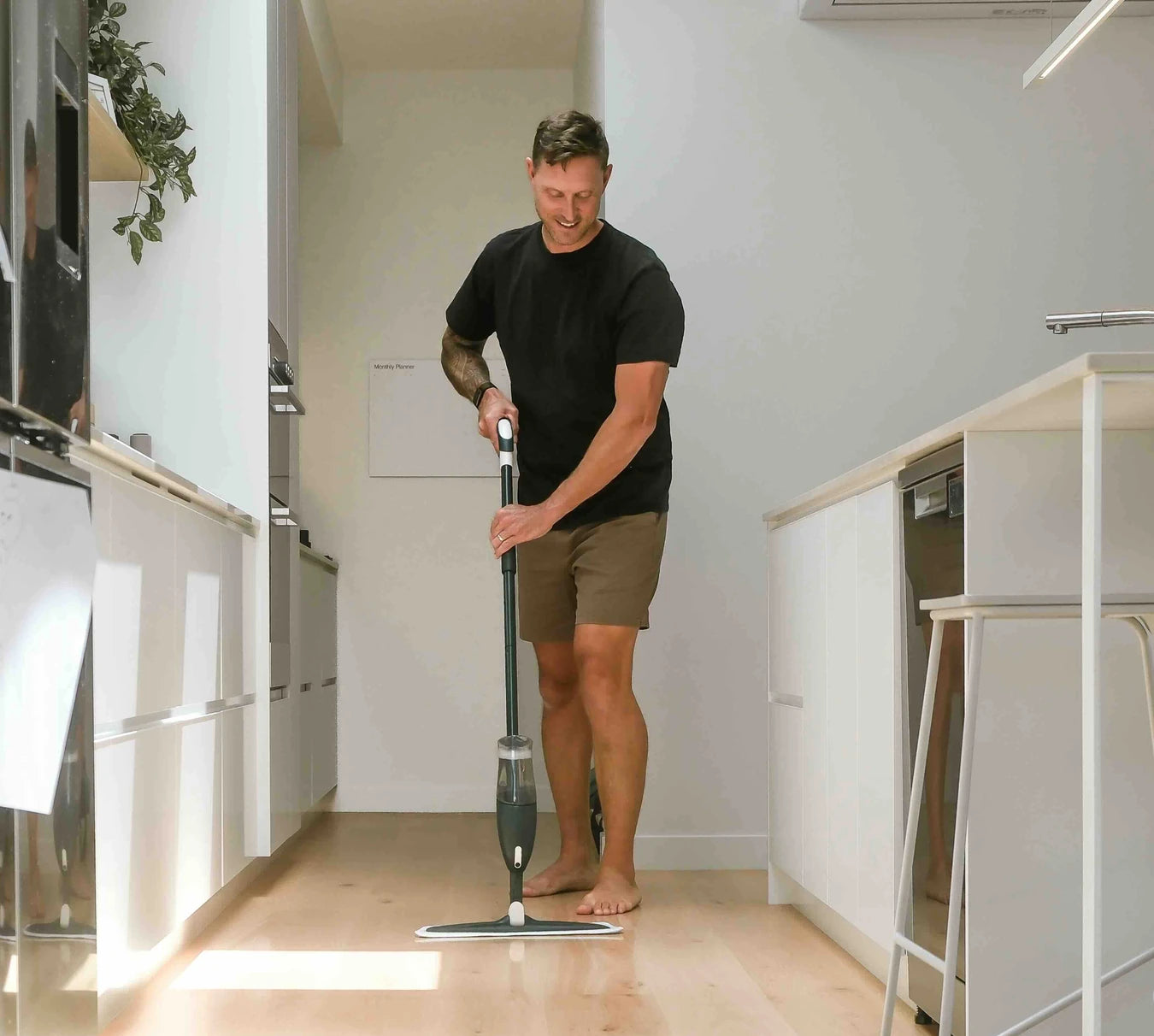
The spray mop is ready to go in under a minute. No filling a bucket, no wringing out a sopping mop head over the laundry sink, no carrying dirty water from room to room hoping you don't slosh it on the carpet. You grab it, you spray, you mop. That's it. For anyone who's ever given up on mopping mid-week because the setup felt like too much effort after a long day, this one change makes a surprising difference.
2. One system for every hard floor in the house
The same mop and cleaner handles the engineered timber in the lounge, the tiles in the bathroom, the vinyl plank in the laundry, and the sealed concrete out by the garage. No switching products, no second-guessing whether your cleaner is safe for that floor. Because the formula is designed to be safe for timber, it's gentle enough for every other hard surface too. One product, one method, done.
3. Safe for the whole household
Our cleaner is made right here in New Zealand and formulated to be safe for wood floors, which means it's free from the harsh chemicals that harder-hitting products rely on. With kids and pets spending a lot of time at floor level, that actually matters. You're not mopping your floor with something you'd hesitate to let your toddler crawl across ten minutes later.
4. Quick enough to actually use on a weeknight
A full mop of an average NZ home takes under 15 minutes with a spray mop. Compare that to dragging out the bucket, filling it, mopping, and then dealing with the cleanup afterwards, and you've saved yourself a decent chunk of time. That's the difference between mopping on a Tuesday night and deciding to leave it until the weekend (and then also leaving it until the weekend after that).
5. A system that grows with your home
As you add replacement microfiber pads, felt furniture pads to protect your floors from scratches, or extra concentrated cleaner, everything works together by design. There's no mixing and matching from different brands or wondering whether a replacement pad will actually fit your mop head. If you're the kind of person who appreciates things that just work together without friction, this matters more than it sounds.
If you're still researching your options, this guide on how to pick the best spray mop for your home covers some useful features to look for when comparing systems.
While You're Protecting Your Floors from the Top Down
The spray mop takes care of what's on your floor, but there's another angle worth thinking about: what's happening at floor level from your furniture. Scratches and scuffs from unprotected chair legs, table bases, and sofa feet are one of the most common causes of floor damage in NZ homes, especially on timber and vinyl plank. Every time a chair scrapes across a board, it drags fine grit particles with it. Over time, that adds up to dull patches and surface scratches that no amount of mopping can fix.
That's where felt floor protection pads come in. Fitted to the bottom of furniture legs, they create a soft barrier between the hard edge of your furniture and your floor surface. Paired with your spray mop system, they give your floors genuine all-round protection: clean from above, cushioned from below.
We stock a range of felt pads through Abstract Floor Care specifically as a complement to the spray mop system, because keeping your floors looking good long-term is about more than just the clean.
The Bottom Line on Spray Mops with Microfiber Pads
Here's the honest summary: a spray mop with quality microfiber pads is not just a more convenient option than a bucket mop. It is actively better for your floors. Less water, more control, pads that actually lift dirt rather than redistribute it, and a system that works with your timber, vinyl plank, or laminate rather than quietly working against it.
The NZ angle matters too. A cleaner made here, formulated with local floors in mind, is a more sensible choice than a globally distributed product that has no idea whether you've got engineered timber in your kitchen or solid native timber in your lounge.
If you're still using a bucket mop on hard floors, the switch is worth making. The entry point is lower than most people expect.
I built this system because I wanted something I'd trust on my own floors at home, with my own kids running through the kitchen. If that sounds like your situation, check out the spray mop here and if you want to know exactly what you're putting on your floors, the concentrated cleaner page explains it all.
Conclusion
The case is clear: a spray mop with microfiber pads simply outperforms the traditional bucket method in every way that matters. You get faster cleaning times, genuinely cleaner floors, a lighter and easier tool to handle, and pads you can wash and reuse for months. No more soaking wet floors, no more hauling heavy buckets, and no more cleaning sessions that leave you exhausted.
If you have been putting off upgrading your cleaning routine, today is the perfect day to make the change. Browse our top-rated spray mop options and find the one that fits your home and budget. Thousands of homeowners have already made the switch and wish they had done it sooner.
Your floors deserve better. More importantly, so does your time and your back. Make the smarter choice and transform cleaning day from a chore into something almost effortless.