



 Everyday Floor Cleaning Starter Kit · $149.00
 Everyday Floor Cleaner Concentrate · $49.00
 Everyday Spray Mop · $94.00
 Replacement Mop Heads · $19.00

Natural Floor Cleaner for Wood Floors: What Actually Works (and What to Avoid)
Sep 23, 2026
You scrub your wood floors, step back, and they still look dull or streaky. Sound familiar? The problem might not be how you're cleaning, it might be what you're cleaning with.
A lot of store-bought cleaners are packed with harsh chemicals that can actually damage wood over time, stripping away the finish and leaving your floors looking worse than before. And some well-meaning "natural" hacks floating around the internet? They can be just as bad.
The good news is that finding a natural floor cleaner for wood floors that actually works is way simpler than you might think. You probably already have the ingredients sitting in your kitchen right now.
In this guide, you'll learn exactly which natural cleaning solutions are safe and effective for wood floors, which popular DIY recipes you should avoid (even though everyone swears by them), and how to put together a simple cleaning routine that keeps your floors looking great. No confusing instructions, no expensive products, just practical tips you can start using today.
Why Wood Floors Need a Gentler Approach
Your timber floors might look solid and tough, but what you're actually cleaning every day is the finish, not the wood itself. That thin protective coating, whether it's polyurethane, lacquer, or hardwax oil, is doing all the hard work. It's the barrier between your beautiful timber and everything life throws at it: muddy boots, spilled juice, and yes, the wrong cleaning product. Here's the thing that catches a lot of people off guard: harsh cleaners break down that finish faster than years of normal foot traffic ever would. Once the coating is compromised, moisture and dirt get direct access to the raw timber underneath, and that's when the real damage begins.
If you're in an older New Zealand home, this matters even more. Native species like rimu, kauri, tōtara, and colonial pine are stunning, but they're genuinely sensitive to both moisture and chemical exposure. These boards have often been refinished multiple times over the decades, which can make the coating thinner and more vulnerable than you'd expect. Newer NZ builds tend to feature engineered timber, which has its own set of needs; the surface veneer is real wood, but the core layers beneath it don't handle excess moisture well at all.
This is where pH comes in, and I promise it's simpler than it sounds. A pH-neutral cleaner sits right in the middle of the scale, around 6 to 8. Anything too acidic (think vinegar, around pH 2.5) or too alkaline (like ammonia-based products) gradually eats away at the finish with every single use. You won't notice it immediately, which is actually the sneaky part.
That delayed reaction is exactly why timber floor damage so often takes people by surprise. By the time you spot the warning signs of floor finish damage, including a cloudy or milky appearance, dull patches that won't buff out, or white streaking across the surface, the problem has usually been building for months. The finish erodes gradually, and the visible failure only shows up once it's already well underway. Using a pH-neutral wood floor cleaner from the start is genuinely the easiest way to avoid getting to that point.
What 'Natural' Actually Means for a Wood Floor Cleaner
So here's something worth knowing before you grab any bottle labelled "natural" off the shelf: that word has no regulated definition when it comes to cleaning products. None. It's essentially a marketing term, and it can mean almost anything. As a dad who's spent way too long reading labels while my kids ran circles around me in the supermarket, I get how frustrating that is.
What you actually want to look for are plant-derived surfactants, specifically the kind that clean effectively without attacking your floor's protective finish. These are ingredients sourced from plants rather than petroleum, and they do a genuinely good job of lifting dirt without leaving a problematic residue behind. Pair that with a pH-neutral formula sitting somewhere between 6.0 and 7.5, and you've got a cleaner that won't slowly degrade the polyurethane or lacquer coating on your floors. Low-VOC or fragrance-free options are worth prioritising too, especially if you've got little ones crawling around at floor level all day.
The ingredients to actively avoid are ammonia, bleach, and harsh petroleum-based solvents. Ammonia sits at a high pH and breaks down polyurethane finishes over time; it's the kind of damage you don't notice until it's too late. Bleach discolours timber and dries it out. Wax-based ingredients are sneaky ones as well; they seem harmless but they build up a dull film on the surface that's genuinely difficult to remove later.
Here's the bit that surprises most people: natural doesn't automatically mean wood-safe. Citrus-based degreasers contain d-Limonene, which is derived from orange rind and sounds perfectly innocent, but it can cause accelerated finish wear on sealed timber floors. Certain essential oil concentrates fall into the same category. The plant origin of an ingredient tells you nothing about how it interacts with your floor's finish chemistry. According to floor care specialists, the type of finish and its compatibility with specific surfactant chemistry matters far more than whether an ingredient sounds natural.
The residue problem is something I think about a lot with our own cleaner. Many products leave behind a thin film after cleaning, and that film acts like a magnet for new dirt. So you end up cleaning more often, the floor looks progressively worse, and you assume it's just wear and tear. A genuinely pH-neutral formula rinses cleanly without depositing anything, which is exactly why floors cleaned with the right product stay cleaner for longer between sessions.
Finally, transparency around ingredients matters, particularly for families with kids and pets spending hours at floor level every day. Knowing what's in your cleaner, and being confident about what isn't, is no longer a nice-to-have. It's something more and more parents are rightly asking for.
The DIY Cleaner Problem (Vinegar, We're Looking at You)
Let's be honest: vinegar has had an incredible run as the internet's favourite DIY everything cleaner. It's cheap, it's in every pantry, and for the last 20 years lifestyle blogs have been recommending it for everything from descaling kettles to mopping floors. A YouTube video asking whether you should use vinegar on hardwood floors has racked up 150,000 views, which tells you just how many people are genuinely wondering about this. The appeal makes complete sense, especially for busy households trying to avoid synthetic chemicals. It feels natural, it costs almost nothing, and your gran probably used it.
Here's the problem though: white vinegar is acetic acid, sitting at a pH of around 2.5. That's genuinely acidic. And the finish on your timber floor, whether it's polyurethane, lacquer, or an aluminium oxide coating, doesn't love acid. Each time you mop with a vinegar solution, you're not doing a dramatic one-time strip, you're slowly degrading the finish layer through repeated chemical exposure. It's subtle, cumulative, and easy to dismiss.
That last part is the trap most people fall into. The floor looks fine after the first month. It still looks okay after six months. But the finish is thinning, and once it's thinned enough, moisture starts getting through to the actual wood underneath. By the time you notice dullness, greyish discolouration, or boards that seem to be lifting at the edges, you're often past the point of a simple recoat. You're looking at a full sand and refinish, which is expensive and disruptive.
Vinegar isn't the only DIY combo worth being cautious with. Dish soap leaves a surfactant residue that builds up with every wash and can interfere with the bonded layers in engineered timber over time. Olive oil blends, popular on Pinterest as a "natural polish," coat the surface rather than cleaning it, attracting dust and creating a hazy film that's a nightmare to remove. Baking soda pastes seem gentle but sodium bicarbonate is abrasive enough to micro-scratch sealed finishes with repeated use.
The logical alternative is a cleaner formulated specifically for wood floors, balanced to a near-neutral pH that cleans effectively without attacking the finish. When you consider that professional floor refinishing typically costs several thousand dollars for an average-sized room, spending a little more on the right cleaner each year isn't really a cost, it's an investment in avoiding a much bigger one later.
Concentrated vs. Ready-to-Use: Why the Format Matters More Than You Think
Here's something most people don't think about when they grab a bottle of floor cleaner off the shelf: roughly 90 to 95% of what's inside a ready-to-use spray is just water. You're essentially paying retail price, plus shipping, for something you already have coming out of your tap. A good concentrated cleaner flips that equation entirely. One small bottle of concentrate can replace dozens of single-use RTU bottles, which means dramatically less plastic waste heading to landfill and far fewer trucks on the road moving liquid weight around the country.
The cost difference adds up faster than you'd expect. If a concentrated cleaner dilutes at around 10ml per 500ml of water, a 500ml concentrate bottle gives you roughly 50 full spray bottles of ready-to-use solution. Do that maths against the per-bottle price of a RTU product and you're often looking at a fraction of the cost per clean. For a busy household where floors are getting mopped a couple of times a week, that's a meaningful saving over a year.
There's also a real advantage to buying a concentrate that's made right here in New Zealand. Local production means shorter transport distances, fresher product when it arrives, and a much cleaner supply chain. You can actually find out where it came from and what's in it, which is increasingly hard to say about imported alternatives.
One thing worth knowing before you start: more product does not mean a better clean. This is genuinely one of the most common mistakes on timber and engineered floors. Using more concentrate than the recommended dilution leaves a residue behind that dulls your floor's finish over time and creates a slightly sticky surface that attracts dirt faster. Cleaning experts consistently flag this as a leading cause of that frustrating hazy film people notice after cleaning. Stick to the ratio on the label.
The final piece is how naturally a concentrate slots into a spray mop setup. Fill the bottle once with correctly diluted solution, clip it onto your mop, and you're ready to go. No measuring every single time, no waste, no guesswork. It's genuinely the most practical system for keeping wood floors clean consistently without overdoing it.
It's Not Just Hardwood: Why Wood-Safe Means Safe Everywhere
Here's a simple way to think about it: if a cleaner is gentle enough to protect sealed timber, it's gentle enough for pretty much every hard floor in your home. The logic holds because a wood-safe cleaner is formulated to avoid the things that damage surfaces generally, stripping protective finishes, leaving sticky residue, swelling materials with excess moisture, or degradating adhesive layers. Those are problems that affect vinyl, laminate, and tiles just as much as timber.
If you've got a newer NZ home, there's a good chance you're already living on a mix of surfaces. Vinyl plank flooring is everywhere in modern builds because it's durable, waterproof, and affordable. But vinyl is surprisingly sensitive to harsh chemical cleaners that can break down its surface coating over time. A gentle, low-moisture approach, the same approach your timber floors need, is exactly right for vinyl too. Same goes for laminate, sealed concrete, and tiles with grout. Grout is particularly vulnerable to strongly acidic or alkaline cleaners, which can slowly erode it. A pH-balanced, wood-safe formula sidesteps that problem entirely.
Engineered timber deserves a special mention because it's become the go-to flooring choice in so many New Zealand homes. Unlike solid timber, engineered boards have a thin real-wood veneer bonded over composite layers. That construction makes them even less forgiving than solid wood when it comes to moisture or harsh chemicals. The veneer is thin enough that damage can be permanent. If your cleaner is safe for engineered timber, you've already cleared the highest bar in the house.
And this is where one good cleaner really earns its place. Instead of keeping separate products for the kitchen tiles, the hallway vinyl, and the living room timber, you use the same bottle everywhere. No guessing, no grabbing the wrong thing, just consistent, safe results across every floor in your home.
Building a Complete Natural Floor Care Routine
Now that you know what to use and why it works, let's put it all together into a simple routine you can actually stick to. This doesn't need to be complicated. Here's how it breaks down.
Step 1: Always Dry Clean First
Before any liquid touches your floor, sweep or vacuum first. This is the step most people skip, and it's the one that causes the most damage. Grit, dust, and debris sitting on your floor act like sandpaper when a wet mop pushes them around. The International Flooring Certification and Inspection Institute is clear on this: regular wood floor maintenance starts with a soft-bristle broom or a vacuum with a soft floor attachment. Thirty seconds of sweeping before you mop can save years of unnecessary finish wear.
Step 2: Use a Spray Mop for Moisture Control
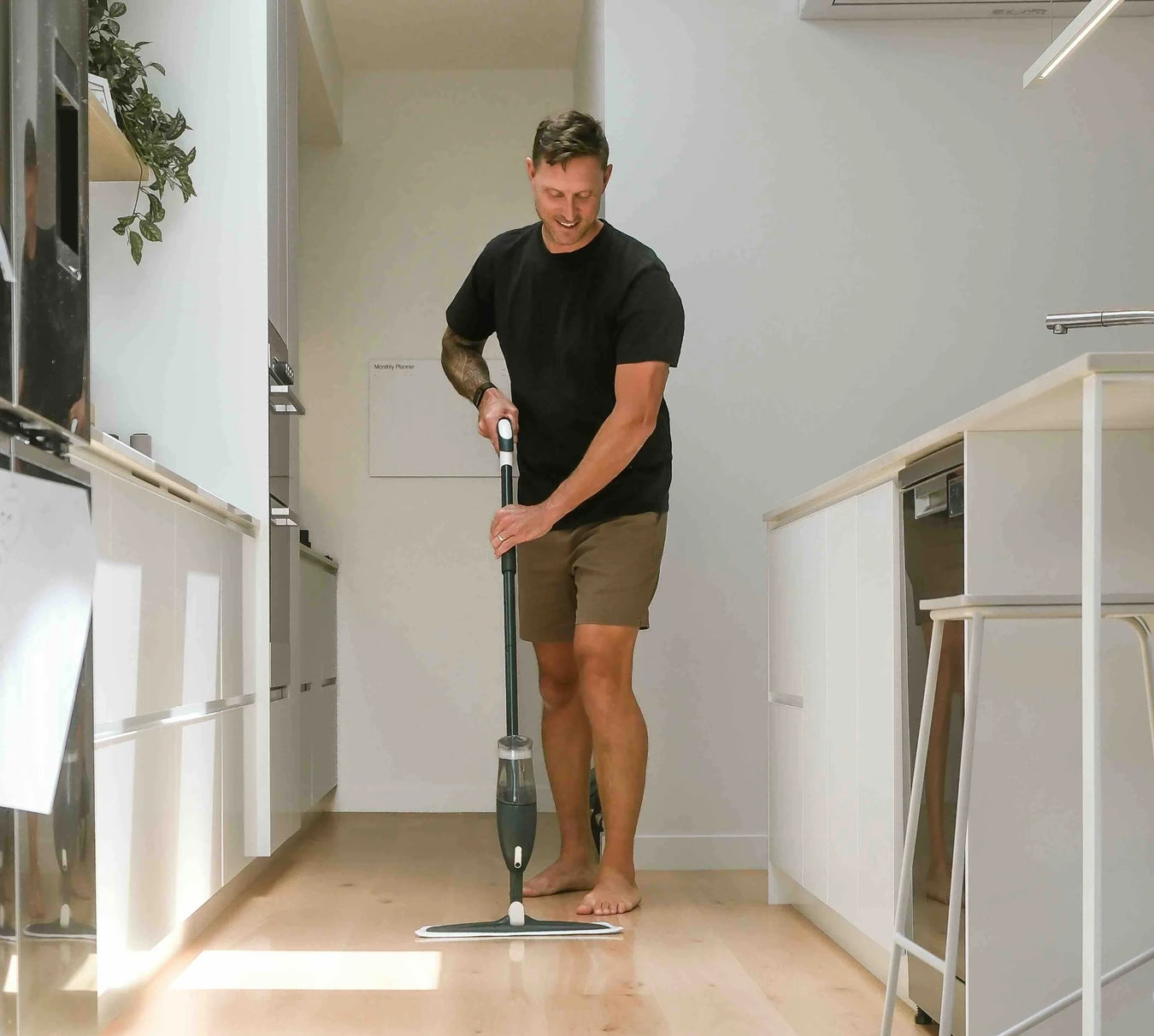
Excess water is one of the most common causes of timber floor damage. Standing water dulls the finish, can warp the boards, and leaves residue behind. A spray mop solves this because you control exactly how much liquid hits the surface. A fine, targeted mist ahead of the mop pad is all you need. It cleans effectively without saturating the floor.
Step 3: Less Cleaner Than You Think
A small amount of properly diluted natural concentrate in your spray bottle is genuinely all you need. You are lightly cleaning a sealed surface, not scrubbing tiles. A little goes a long way, especially with a quality concentrate.
Add Felt Pads as Your Passive Protection Layer
Furniture legs dragging across timber floors cause cumulative scratch damage that adds up fast. Felt pads on chair and table legs work quietly in the background between every clean, protecting the finish in ways mopping simply cannot. They are part of the same floor care mindset.
How Often Should You Actually Mop?
For most busy households, a full mop once a week is enough. Spot clean high-traffic areas like the kitchen or hallway in between to keep things looking good without over-wetting the surface over time.
Quick Reference: What to Look for in a Natural Wood Floor Cleaner
If you've made it this far through this guide, you're clearly someone who actually cares about what goes on your floors (and into the air your family breathes). So here's a quick checklist you can screenshot or bookmark for next time you're shopping.
pH-neutral formula (pH 6 to pH 8). This is the non-negotiable. Anything outside this range, either too acidic or too alkaline, risks breaking down your floor's protective finish over time. A damaged finish means moisture gets in, and that's when your timber starts to warp, dull, or stain.
No ammonia, bleach, harsh solvents, or wax-based ingredients. Wax deserves a special mention here: it might make your floors look shiny at first, but it builds up layer by layer and eventually turns cloudy and sticky. It also makes future refinishing a nightmare.
Low-VOC or VOC-free. If you've got kids crawling around, pets napping on the floor, or anyone in the house with asthma or allergies, this one really matters. VOCs off-gas into your indoor air long after cleaning.
Rinse-free. A cleaner that needs rinsing is leaving something behind. Full stop.
Concentrate format. Less plastic, less storage space, better value. It's a straightforward win on every front.
Transparent ingredients. If the label is vague, keep walking. A brand confident in its formula will tell you exactly what's in it.
The Bottom Line on Natural Wood Floor Cleaners
Here's the honest summary after everything we've covered: natural floor cleaning really isn't complicated. The best natural floor cleaner for wood floors is pH-neutral, made with ingredients you can actually identify, leaves zero residue behind, and is applied with the right amount of moisture. That's it. You don't need a chemistry degree or a cupboard full of products.
The two shortcuts that quietly cost people the most are vinegar and generic multi-surface sprays. Both seem fine in the short term, but both work against your floors over time, dulling finishes, leaving films, and potentially voiding the warranty on a floor you paid good money for.
The smarter approach is a spray mop paired with a purpose-built concentrated cleaner. It's a low-waste system, it's genuinely affordable over time, and it takes the guesswork out of getting the moisture level right on timber surfaces.
If you want something that was made here in New Zealand with exactly these floors in mind, that's what Abstract Floor Care's spray mop and concentrated cleaner system is built for. It ticks every box on the checklist above and works across engineered timber, solid wood, laminate, vinyl plank, and tiles. A good place to start if you're done second-guessing what you're putting on your floors.
Conclusion
Keeping your wood floors clean does not have to mean choosing between harsh chemicals and ineffective DIY hacks. Here is what to remember: simple, pH-neutral solutions work best; vinegar and soap-based cleaners can silently damage your finish over time; and a consistent, low-moisture routine is your floors' best friend.
The right natural cleaner is probably already in your kitchen, waiting to do the job safely and effectively.
Now it is your turn. Pick one of the safe, natural solutions from this guide and give your floors a test clean this week. Notice the difference a gentle, wood-safe approach makes, not just in how your floors look, but in how long they stay looking that way.
Your floors are worth protecting. Start simple, stay consistent, and they will reward you with years of warmth and beauty.